The first hard freeze in the Shenandoah Valley has a way of finding every weak point in a building’s plumbing at once. For facility managers, a single burst pipe can mean flooded space, emergency repair costs, and days of disruption. The good news: freeze damage is largely preventable, and late summer is the right time to plan commercial plumbing freeze protection before the cold arrives.
Why now is the time to plan freeze protection
Freeze protection is far cheaper and easier to address before the temperature drops. Planning in late summer or early fall gives you time to inspect vulnerable areas, schedule any corrective work, and get ahead of the winter rush — instead of scrambling for an emergency plumber during the first cold snap when every other facility in the region is calling too.
It’s also budget season for many building owners and managers. Identifying freeze risks now lets you fold any needed repairs into planning rather than absorbing them as an unplanned emergency.
Where commercial buildings are most vulnerable
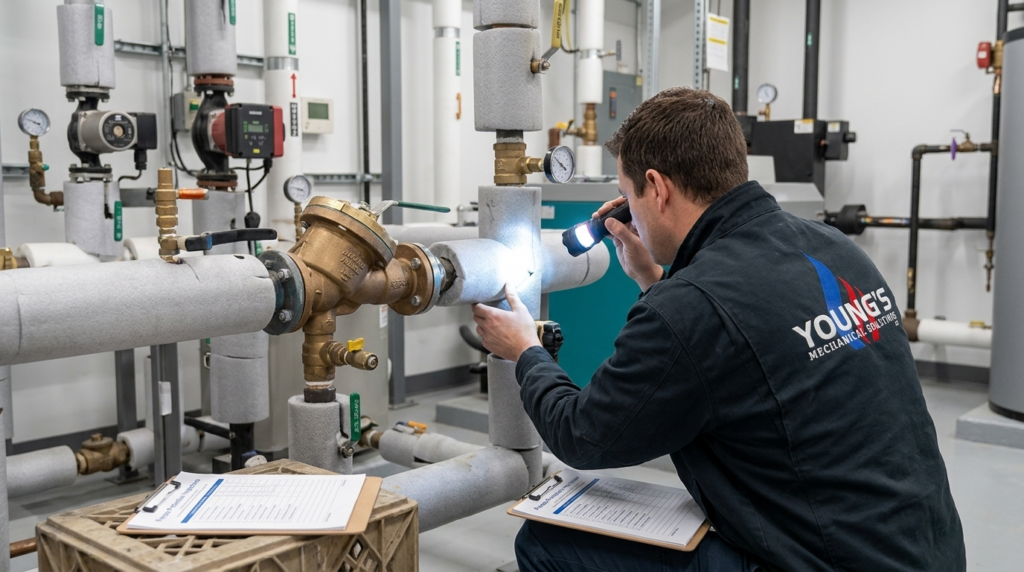
Commercial plumbing runs through a lot of unconditioned and exposed space. The most common freeze-damage points we see in Valley facilities include:
- Exposed piping in unheated areas — attics, crawl spaces, mechanical rooms, and parking structures.
- Backflow preventers and exterior connections that sit in cold or partially exposed locations.
- Rooftop and exterior wall penetrations where piping meets outside air.
- Hose bibs, hydrants, and irrigation lines that need to be drained or isolated before winter.
- Low-flow or dead-leg lines in seldom-used areas where water sits still and freezes first.
Each of these can be protected with the right combination of insulation, heat trace, drainage, and seasonal shut-down procedures — but only if it’s identified ahead of time.
The real cost of a burst pipe
When a commercial line freezes and bursts, the repair itself is often the smallest part of the bill. Water damage to finishes, inventory, and equipment, lost use of the space, and emergency-rate service calls add up quickly — and the timing is never convenient. A planned pre-winter inspection replaces that risk with a predictable, scheduled visit and a clear list of what your building needs.
One mechanical partner for plumbing and HVAC
Because Young’s Mechanical runs in-house plumbing and mechanical piping crews alongside our HVAC teams, we can look at your building’s freeze exposure as a whole — from the water lines to the heating system that keeps those spaces above freezing. We serve roughly a one-hour radius of Harrisonburg and are licensed in both Virginia and West Virginia, so facilities across the Valley have one commercial partner for the full scope of winterization.
A pre-winter plumbing checklist
Before the first freeze, it’s worth confirming a few things for each facility you manage:
- Are exposed and exterior lines insulated and, where needed, protected with heat trace?
- Have irrigation and unused exterior lines been scheduled for draining and shut-down?
- Are backflow preventers and exterior connections protected from the cold?
- Do you know where your building’s most vulnerable, seldom-used lines are?
- Is there a plan — and a partner — in place if a line does freeze?
Walking that list now, while the weather is still mild, is one of the simplest ways to protect your facility’s uptime through winter.
Plan your freeze protection before winter
A little planning in late summer prevents a lot of disruption in January. If you’d like a professional set of eyes on your building’s commercial plumbing freeze protection, reach out to discuss a service agreement for your building, or contact our team at 540-214-2745 to schedule a consultation to walk your facility.