When a commercial heating system reaches the end of its life, the fastest answer is usually the wrong one: replace it with the same size that was there before. Fall is when many building owners and developers start planning heating equipment replacements for the year ahead — and the decision that shapes the next fifteen years of operating cost is not which brand goes in, but whether the equipment is actually sized to the building. Right-sizing commercial heating equipment starts with a real load calculation, not a like-for-like swap.
Why right-sizing commercial heating equipment protects your budget
Heating equipment that is too large costs money in ways that are easy to miss. An oversized boiler or furnace short-cycles — firing, satisfying the space quickly, shutting off, and repeating — which wastes fuel, wears components faster, and delivers uneven comfort. Undersized equipment runs constantly and still cannot hold setpoint on the coldest days. Either way, the building pays for the mismatch every year the system is in service.
The original equipment is often a poor guide to the right size. Buildings change: insulation is upgraded, windows are replaced, occupancy shifts, additions are built, and the first system may have been oversized to begin with. Sizing the replacement to the building as it exists today is how those savings get captured instead of carried forward.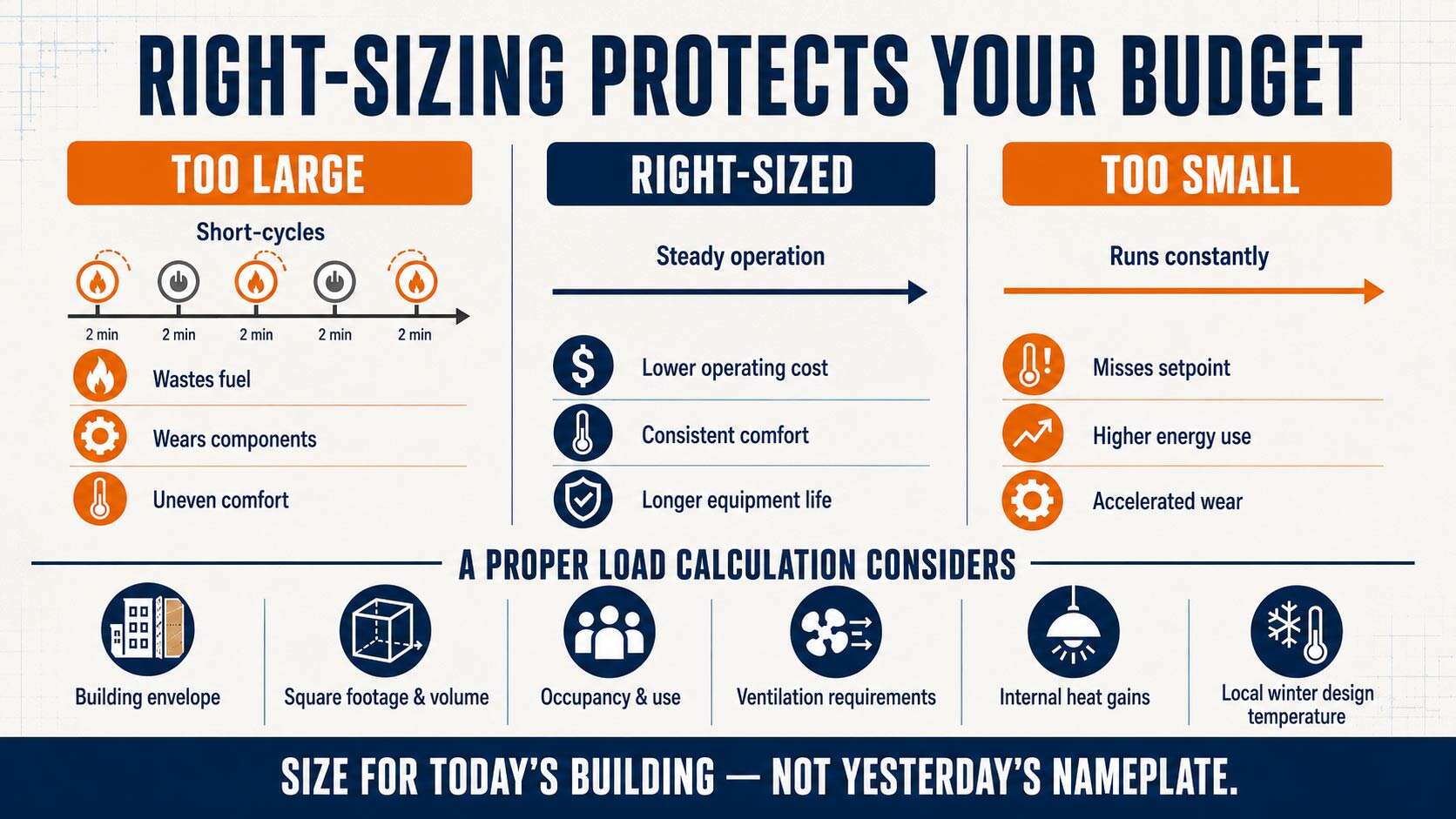
What a proper load calculation accounts for
A load calculation is the engineering that tells you how much heating a space actually needs. Rather than guessing from the old nameplate, it accounts for the factors that drive real demand:
- Building envelope — insulation levels, wall and roof construction, and window area and performance.
- Square footage and volume — including high-bay or open spaces that behave differently than standard offices.
- Occupancy and use — how many people, what hours, and what the space is used for.
- Ventilation requirements — the outdoor air a commercial building has to condition and heat.
- Internal gains — equipment, lighting, and processes that add heat to the space.
- Local climate design conditions — the actual winter design temperatures for the Shenandoah Valley, not a generic assumption.
The output is equipment sized to the building’s real load — which runs more efficiently, more comfortably, and longer than a system chosen by habit.
Sizing is a long-view decision for owners
For building owners and developers, a heating replacement is a capital decision that lives with the building for a decade or more. Right-sizing lowers operating cost every year the equipment runs, and those savings compound. It also affects comfort, tenant satisfaction, and how well the space performs — all of which factor into the value of the asset. Spending a little engineering effort up front to size the system correctly is one of the highest-return decisions in the whole replacement.
Design-build capability, in-house
Because Young’s Mechanical is a design-build mechanical partner, we can engage early — running the load calculation, evaluating the existing system, and recommending equipment sized to how your building actually performs, then installing it with our own crews. That means the team that sizes the system is the same team accountable for how it runs. Our leadership brings decades of commercial mechanical and construction experience to that engineering, so the numbers behind your replacement hold up.
We serve roughly a one-hour radius of Harrisonburg and are licensed in Virginia and West Virginia, giving owners across the Valley one partner from load calculation through installation and long-term service.
Questions to ask before a heating replacement
Before you approve a commercial heating replacement, it is worth confirming:
- Is the new equipment sized from a current load calculation, or matched to the old unit?
- Has the building’s envelope, occupancy, or use changed since the last system went in?
- Does the proposal explain why this capacity, not just which model?
- Is efficiency being evaluated over the equipment’s life, not just the install price?
A contractor who can answer those clearly is protecting your operating budget, not just filling an order.
Plan your heating replacement the right way
The size of your next heating system shapes its cost and comfort for years. Right-sizing commercial heating equipment with a real load calculation is how owners and developers get a system that pays back over its whole life. To plan a heating replacement for your building, request a proposal for your next commercial project, or contact our team at 540-214-2745 to schedule a consultation to walk your facility.