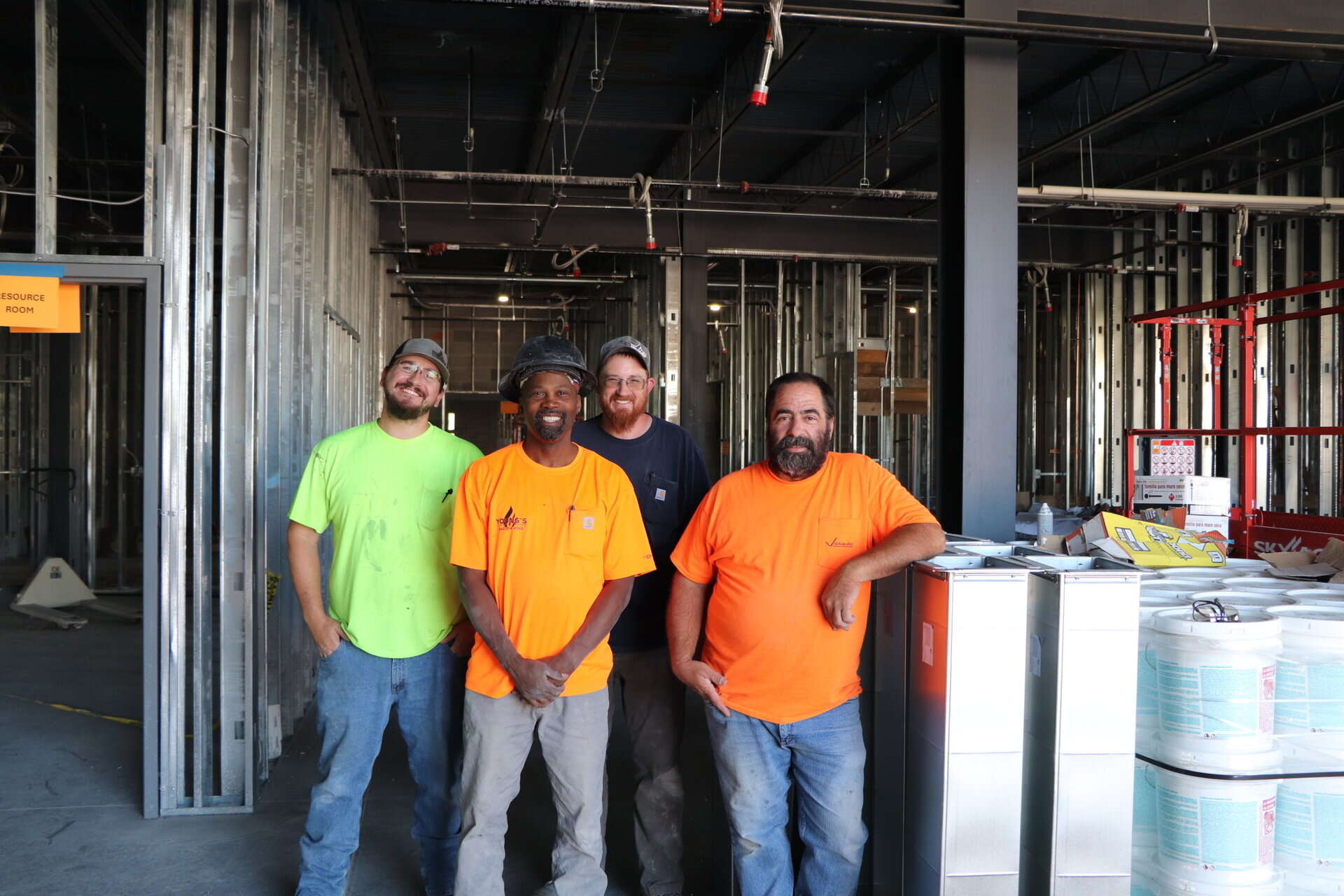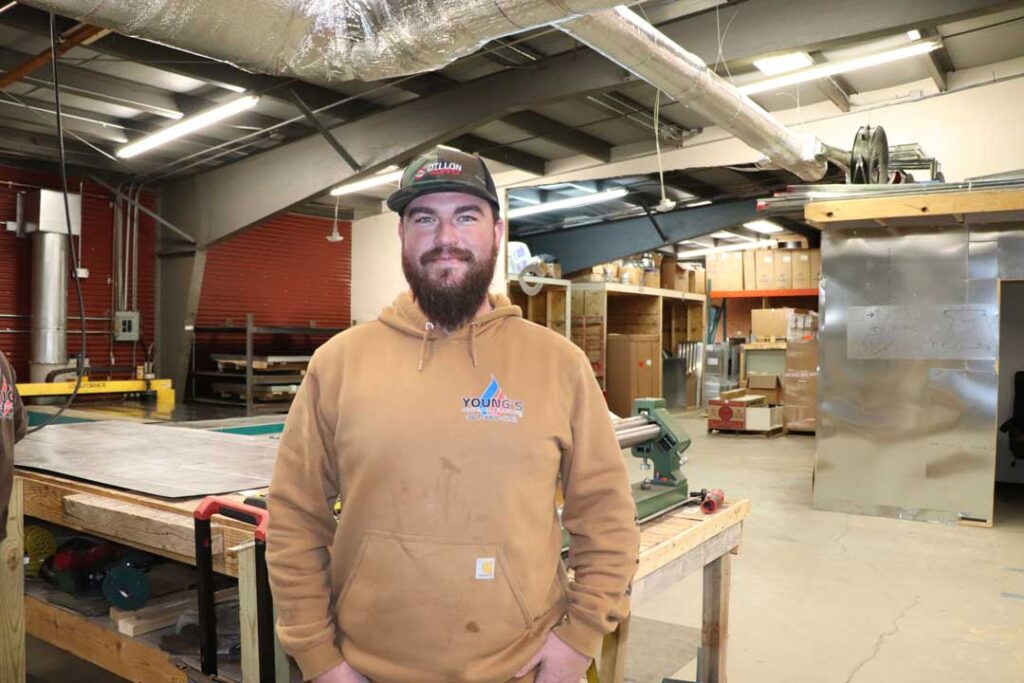
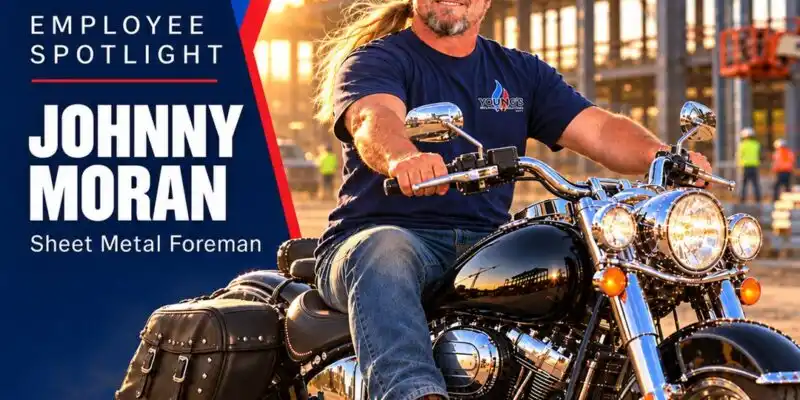
Employee Spotlight: John Moran

This month, we’re shining the spotlight on John Moran, a valued member of the Young’s Mechanical Solutions team who has been with the company for 2 years and 9 months. During his time here, John has become known for his dedication, willingness to learn, and commitment to helping those around him succeed.

One accomplishment John is especially proud of is sharing his knowledge with his crew and others he works alongside. He believes that helping others learn and grow strengthens the entire team and contributes to everyone’s success.

Since joining Young’s Mechanical Solutions, John says he has experienced tremendous professional growth. The environment and the people he works with have continually motivated him to push himself, work harder, and never stop learning new ways to improve. He credits the team around him for encouraging him to grow both personally and professionally.

When asked what advice he would give to someone new to the field, John keeps it simple: “Pack your lunch and show up on time.” He believes reliability, consistency, and a strong work ethic are key ingredients for success.

John first became interested in joining the company after learning about Young’s Mechanical Solutions through Danny. What keeps him here today is the positive environment and the people he works with every day. He describes the company culture as “one big family,” a sentiment that reflects the close-knit team atmosphere many employees value.

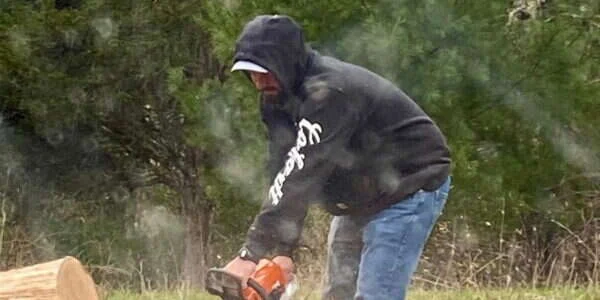
Outside of work, John enjoys playing music, riding motorcycles, and BBQing. A fun fact many coworkers may not know is that he enjoys watching cooking shows, always looking for new ideas and inspiration.

When asked how he would describe the company’s values, John summed it up perfectly: “Full speed ahead. You are great people, and I enjoy working for you.”

Thank you, John, for your hard work, positive attitude, and the knowledge you share with others every day. We’re grateful to have you as part of the Young’s Mechanical Solutions family!
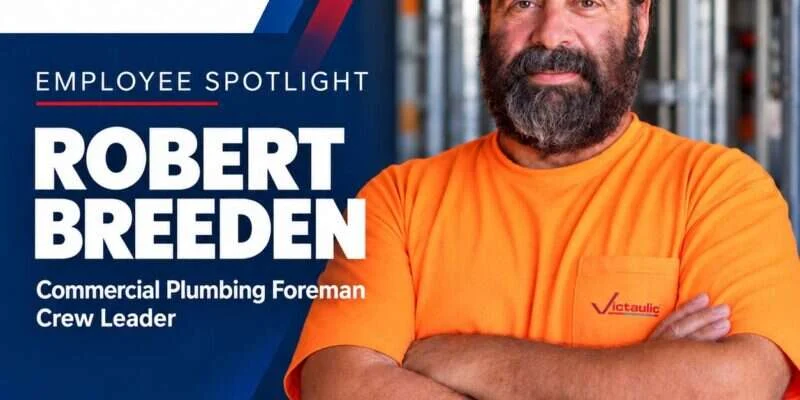
Employee Spotlight: Robert Breeden

At Young’s Mechanical Solutions, we’re proud to have team members like Robert Breeden on our plumbing team. Robert is known for his honesty, dependable work ethic, and commitment to doing things the right way.

Whether he’s helping a customer, supporting a coworker, or tackling a challenging project, Robert consistently brings professionalism, integrity, and pride to his work. His dedication to quality workmanship and outstanding service reflects the values that make Young’s Mechanical Solutions a trusted name in our community.

Thank you, Robert, for all you do. We’re grateful to have you on the team!

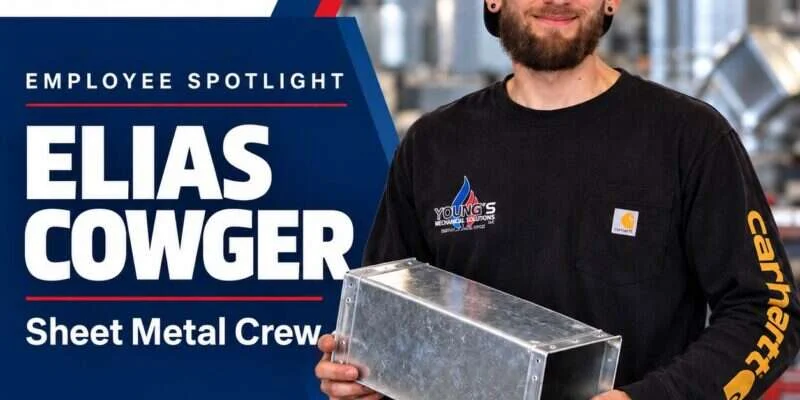
Employee Spotlight: Elias Cowger

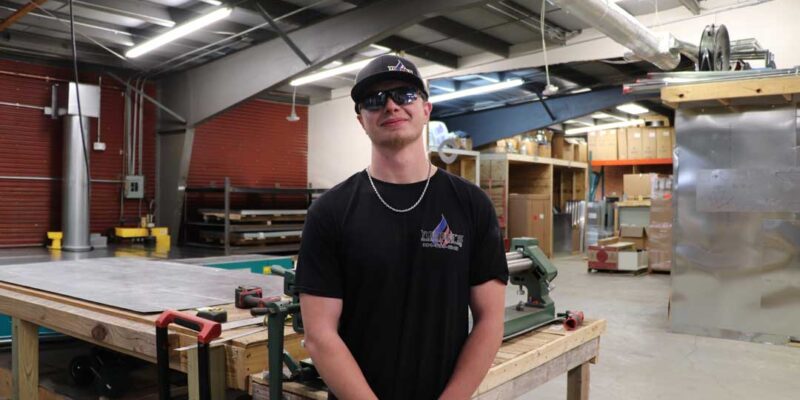
We’re proud to recognize one of our Sheet Metal Installers, Elias Cowger for his hard work, determination, and positive attitude. While working full-time in the field, he’s also taking night classes to continue building his skills and investing in his future. Always willing to lend a hand and go the extra mile, he consistently steps up whenever needed. His dedication to learning and growing makes him a great example of what it means to be part of the YMS family.  We are excited to see your bright future unfold.  Thank you for all you do, Eli!!

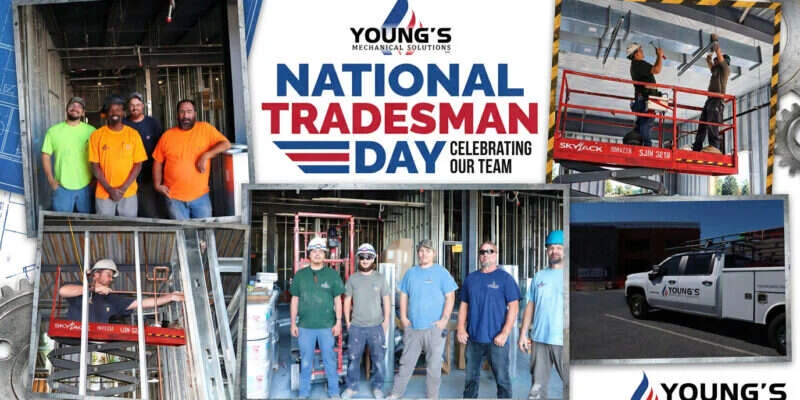
National Tradesmen Day: Honoring the Crews Behind Every Building

Friday, September 18 is National Tradesmen Day. At Young’s Mechanical Solutions, the shop is quiet and the trucks are parked. Our crews are home, and that is exactly where we want them to be.

There is no better way to mark a day built around skilled tradespeople than to give them the day. So while a lot of companies will post a graphic and keep working, our sheet metal mechanics, pipefitters, plumbers, and service technicians are out riding, grilling, hiking, and spending the day with their families. They earned it in the ductwork and the mechanical rooms of buildings all across this valley.

Why our crews are off on National Tradesmen Day

Young’s Mechanical runs a four-day work week. That is not a holiday schedule or a slow-season adjustment — it is how we operate. Monday through Thursday our crews put in full, hard days on commercial job sites and in our Harrisonburg fabrication shop. Friday belongs to them.

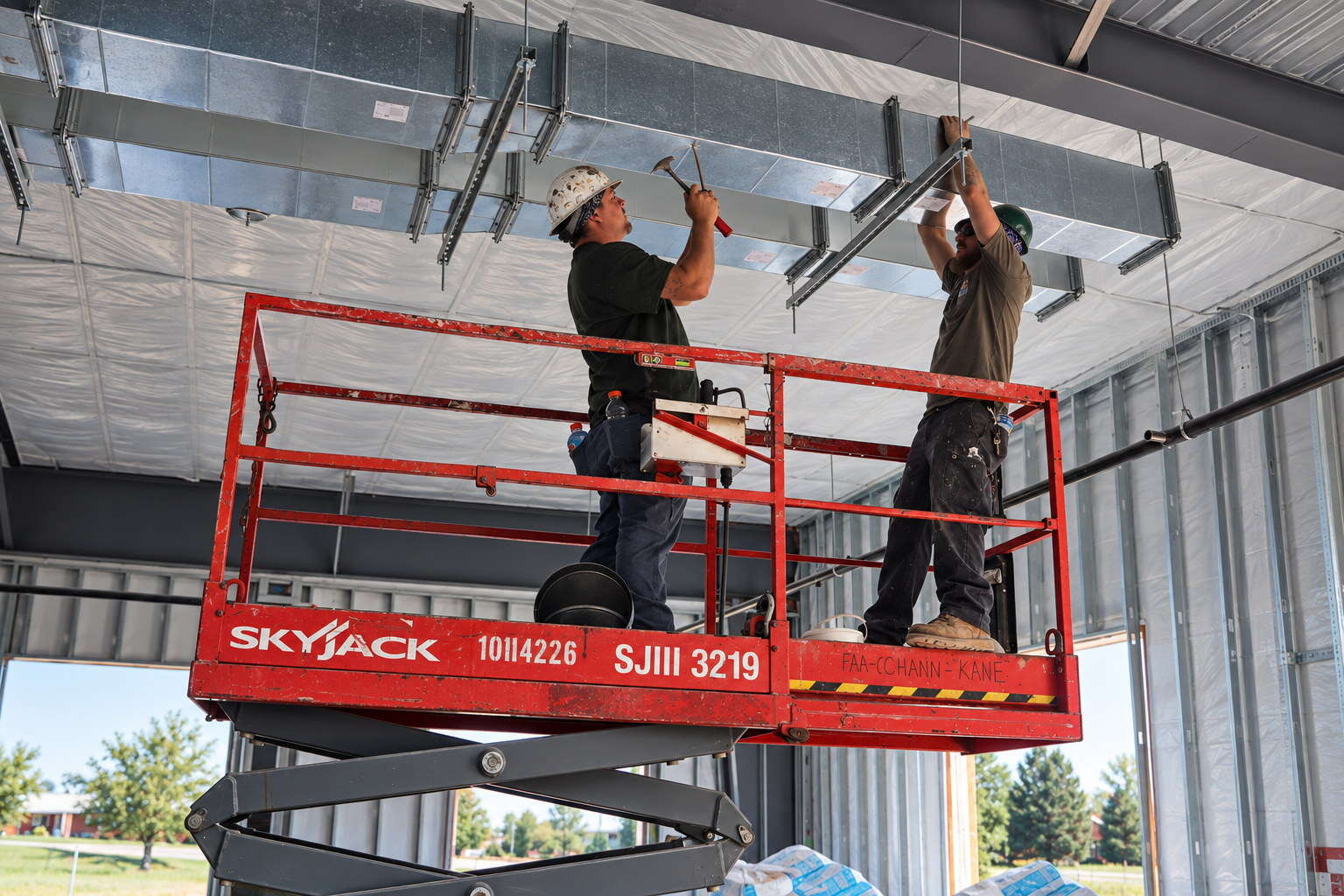
We built the schedule that way on purpose. Commercial mechanical work is demanding. It is hot in the summer, cold in the winter, and it happens on rooftops, in crawl spaces, in ceilings, and in mechanical rooms most people will never see. Someone who does that kind of work for a living should have real time to be a husband, a father, a hunter, a rider, a coach, a neighbor. A crew that gets that time shows up sharper, works safer, and stays longer. That has been true for us since Jake and Darla started this company in 2019.

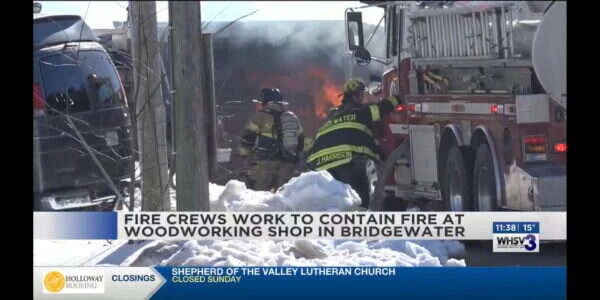
General manager Jonathan Harrison enjoys various adventures outside of his role at our company. You may find him snowmobiling out of state or fighting fires in our local community!

So today, the appreciation is not a slogan. It is a day off, and a thank you.

The work nobody sees is the work that keeps buildings running

Think about the buildings you were in this week. A school. A restaurant or a brewery. A doctor’s office. A warehouse or a manufacturing floor. Every one of them had air moving through it, water running in it, and heat or cooling holding it at a temperature people could work in.

None of that happens on its own. Somebody laid out the ductwork. Somebody fabricated the fittings, hung the piping, set the rooftop unit, ran the controls, and made the whole system talk to itself. Somebody came back at 6 a.m. when a unit went down and got the building open on time.

That is the trades. The measure of the work is that nobody has to think about it. A facility manager who never thinks about the mechanical system is looking at the finished product of a lot of skilled hands.

It is skilled work, too. Reading prints, laying out a run, sweating a joint, balancing a system, troubleshooting a control sequence — these take years to learn and a lifetime to master. There is real craft in it, and real pride.

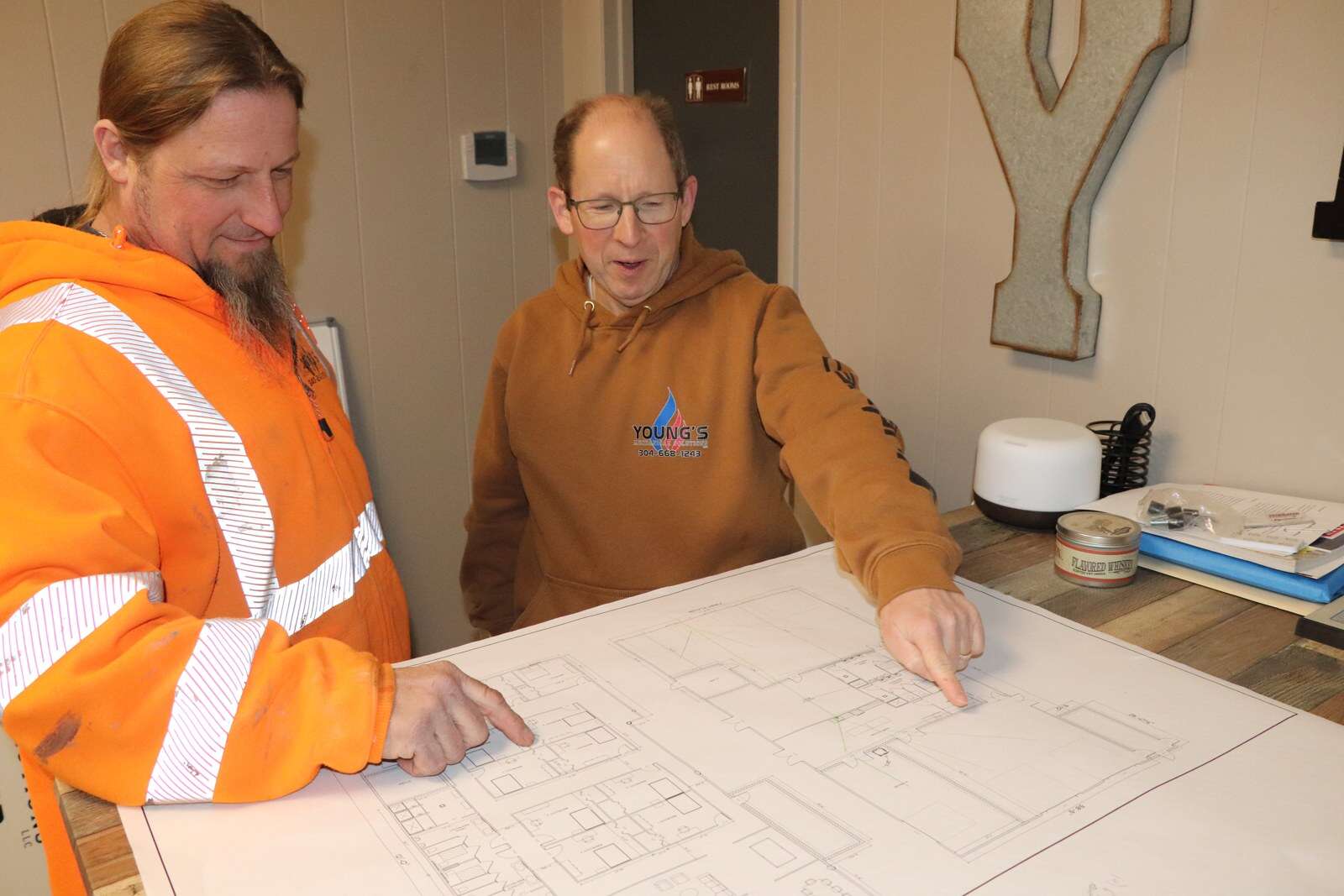
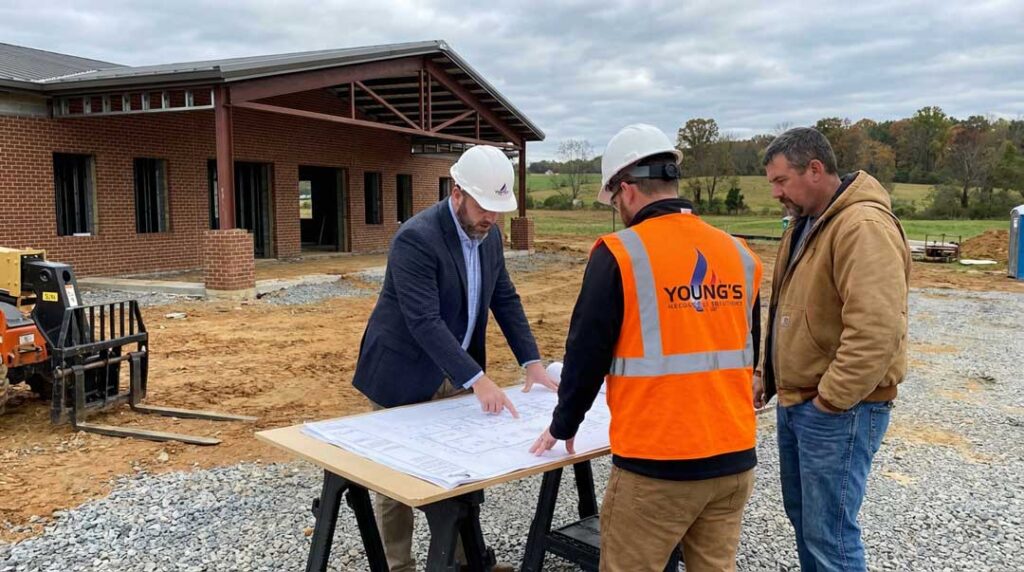
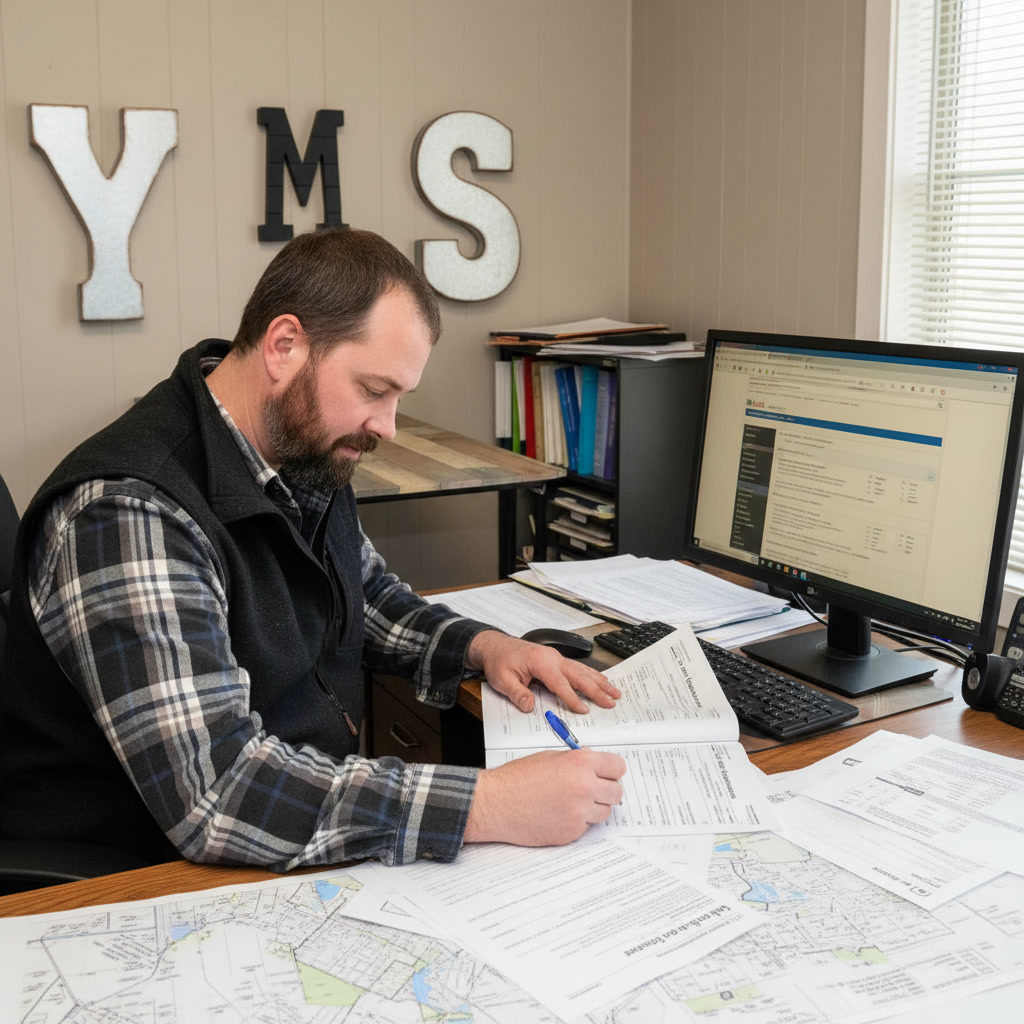
Young's Mechanical Solutions staff reviewing commercial project plans — leadership, planning
Reviewing project plans.

The trades built this country

Every road, bridge, factory, hospital, school, and plant in America was put there by tradespeople. Not by ideas alone, and not by drawings alone. By welders, electricians, carpenters, masons, operators, pipefitters, plumbers, and sheet metal workers who showed up and built it.

That is worth saying plainly, because for about a generation this country quietly taught young people that a trade was a fallback. It never was. A skilled trade is a career that pays well, cannot be outsourced, cannot be automated away, and leaves something standing behind you that you can drive your kids past twenty years later and point at.

The dignity in that work is not something anyone grants to tradespeople. It is already there, in the work itself. The most we can do is recognize it, pay for it fairly, and make room for the next generation to step into it.

Building the next generation of tradesmen in the Shenandoah Valley

The skilled trades gap is real, and the Shenandoah Valley feels it like everywhere else. Experienced mechanics are retiring faster than new ones are coming up behind them.

We take that seriously. Bringing people along in this trade means giving them real work, real instruction, and a reason to stay. That is part of why we keep our crews in-house — sheet metal, mechanical piping, plumbing, controls, and ductwork fabrication all under our own roof. It means a person can learn the trade start to finish here instead of picking up pieces of it from a rotating cast of subcontractors.

If you know a young person who likes working with their hands, who wants to learn something hard and be paid to do it, point them toward the trades. There is a career waiting there, and the Valley needs them.

We are grateful to our team for all they do!
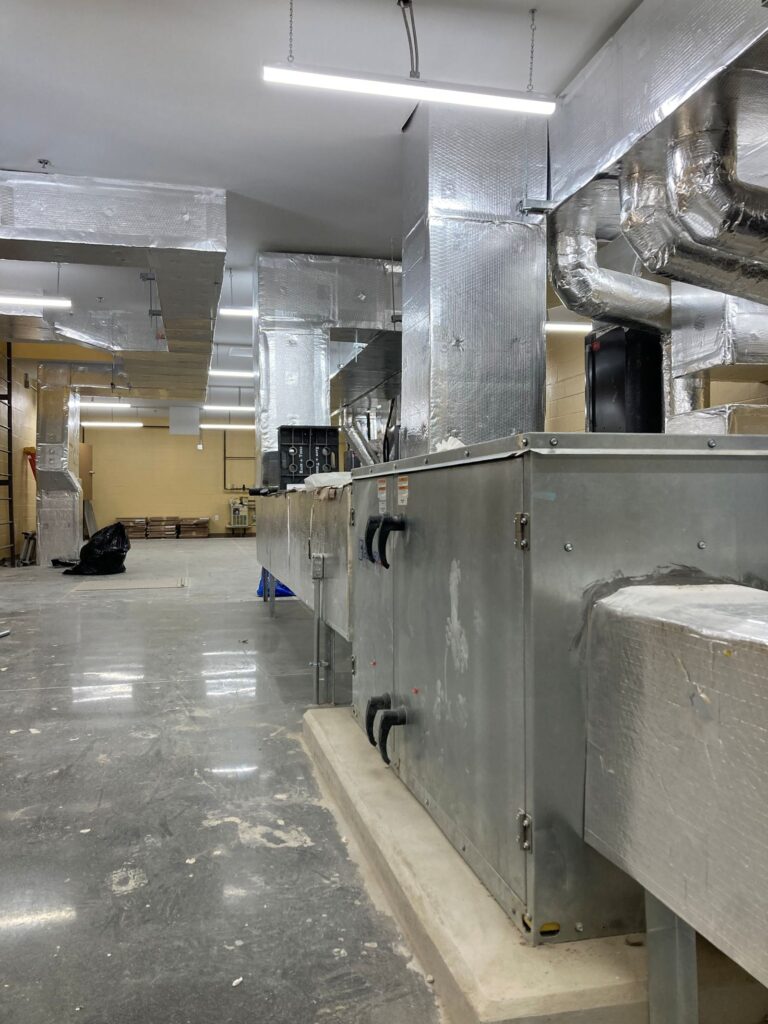
To the crews at Young’s Mechanical Solutions: thank you. You are the reason general contractors trust us to hold a schedule and facility managers trust us with their buildings. The quality of this company is the quality of your work, and everyone who works with us knows it.

And to every tradesperson across Harrisonburg, Rockingham County, the Shenandoah Valley, and West Virginia — whatever trade you work in, whoever you work for — today is yours. Enjoy it.

We will be back at it Monday morning.

Young’s Mechanical Solutions is a commercial-only HVAC, plumbing, and mechanical contractor based in Harrisonburg, Virginia, serving general contractors, facility managers, and building owners across the Shenandoah Valley and West Virginia. To talk with our team about a project or a service agreement, contact our service team at 540-214-2745.

Interested in a career in the commercial trades? We are always glad to talk with experienced mechanics and with people who want to learn. Visit our careers page or call 540-214-2745.

From Trade School to Lead Mechanic: What a Career Path Looks Like at a Growing Valley Mechanical Contractor

For someone leaving trade school or thinking about a career change into the skilled trades, the most important question isn’t the first paycheck. It’s where the work leads in five, ten, and twenty years. At a commercial-only mechanical contractor like Young’s Mechanical Solutions, the path from a first-year apprentice to a lead mechanic is real, well-defined, and built on the kind of steady commercial work that keeps the trades worth doing. Here’s what that career arc actually looks like.

Why Commercial Mechanical Is a Career, Not Just a Job

The skilled trades have been undervalued for a generation, but that’s changing fast. Commercial buildings are getting more complex, mechanical systems are getting more sophisticated, and there’s a measurable shortage of people who actually know how to install, service, and troubleshoot them. The technicians who learn the work now are entering a field with rising demand and rising wages — and a level of job security that white-collar work increasingly can’t match.

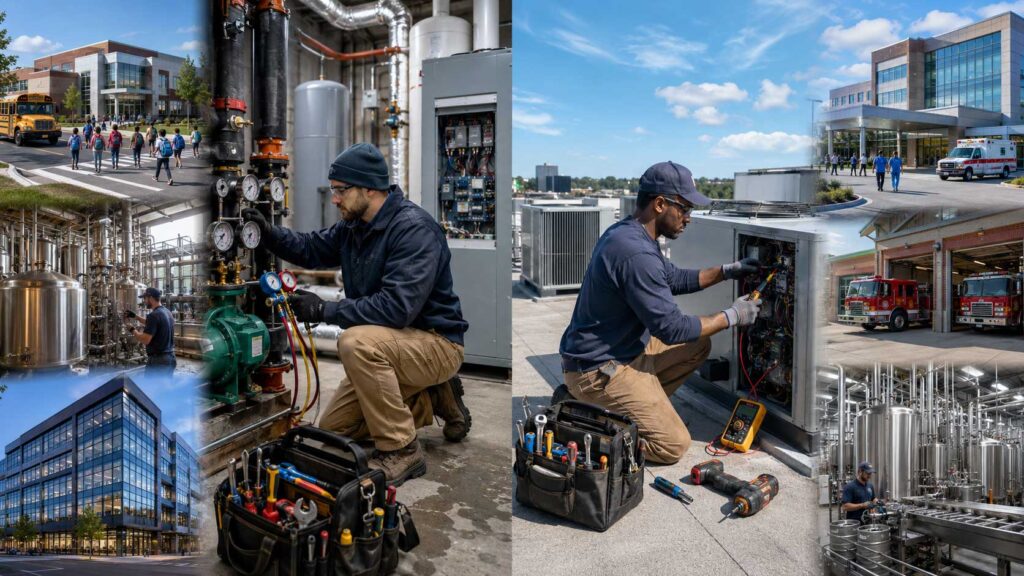
Commercial mechanical work specifically is a strong place to land because the work is varied, the equipment is interesting, and the buildings matter. We work on schools where students are trying to learn, breweries that have to keep producing, healthcare facilities where comfort affects patient care, fire stations that protect our community, and offices where people spend half their waking hours. There’s real satisfaction in keeping those systems running.

It’s also indoor work in winter and on most rooftops in summer — not roofing, not road construction, not jobs that beat you up year-round. The work is physical, but it’s the kind of physical that keeps you healthy rather than wearing you out.

Year One: Apprentice

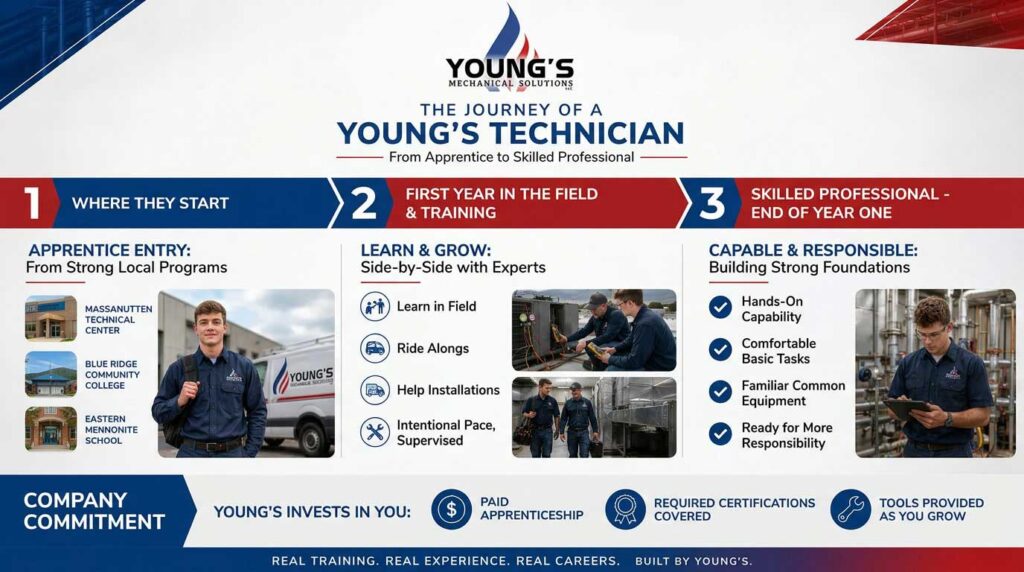
A new technician at YMS starts as an apprentice, typically straight out of trade school or a related program at a community college or a high school career and technical center. Schools like Massanutten Technical Center, Blue Ridge Community College, and Eastern Mennonite School’s career programs all turn out graduates we’re happy to bring on.

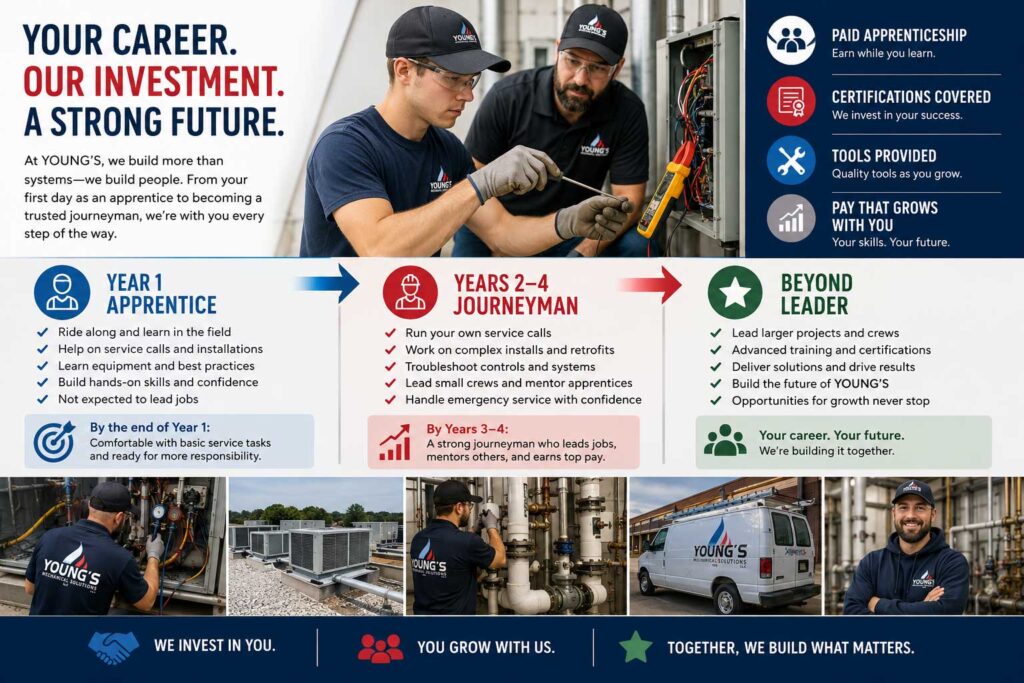
The first year is about learning the work in the field with a more experienced mechanic. Apprentices ride along on service calls, help on installs, learn the equipment, and build the muscle memory that turns book knowledge into hands-on capability. The pace is intentional — nobody is asking a first-year tech to lead a job alone.

By the end of year one, an apprentice should be comfortable with basic service tasks, familiar with common equipment, and ready to start carrying more of the load on bigger jobs. We pay during apprenticeship, we cover required certifications, and we provide the tools as the technician grows into them.

Years Two through Four: Journeyman

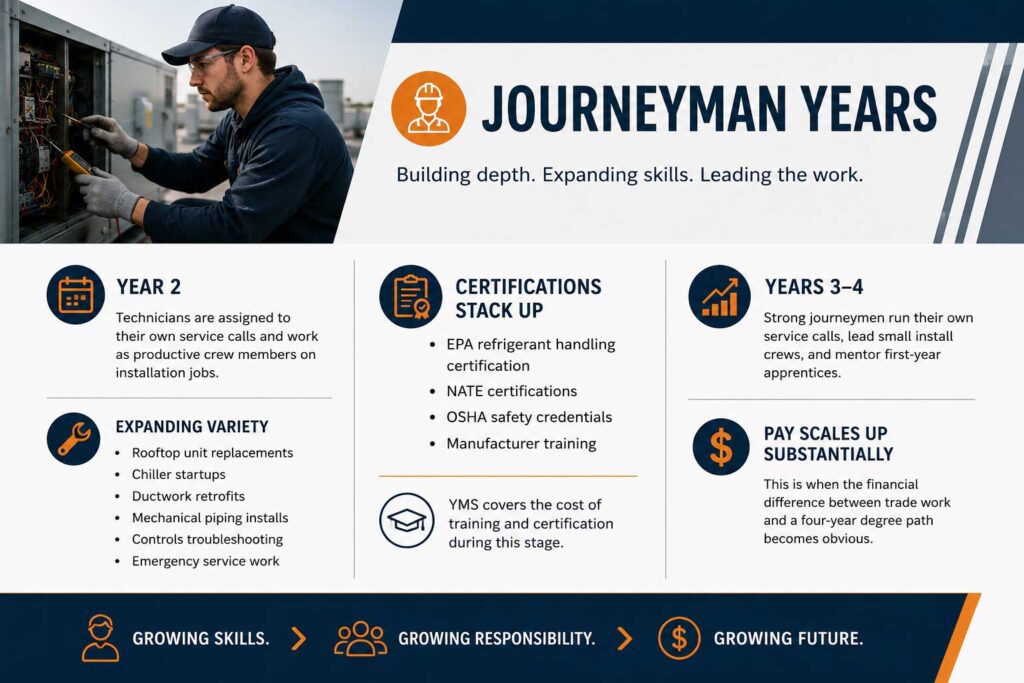
The journeyman years are where the real depth gets built. By year two, a technician is regularly assigned to their own service calls or working as a productive crew member on installation jobs. The variety of work expands — rooftop unit replacements, chiller startups, ductwork retrofits, mechanical piping installs, controls troubleshooting, and emergency service work.

This is also when certifications start stacking up. EPA refrigerant handling certification, NATE certifications, OSHA safety credentials, and any specialized manufacturer training all happen in this window. YMS covers the cost of training and certification for technicians moving through this stage.

By year three or four, a strong journeyman can run their own service calls, lead small install crews, and start mentoring the first-year apprentices coming behind them. Pay scales up substantially during this period — this is when the financial difference between trade work and a four-year degree path becomes obvious.

Year Five and Beyond: Lead Mechanic and Foreman

The next step is lead mechanic or crew foreman — the technicians who run jobs, mentor apprentices, and own the quality of the work that goes out the door. Lead mechanics at YMS are the people customers know by name, the ones who walk a job with the facility manager and explain what needs to happen and why. They’re also the technical resource other techs lean on when something unusual comes up.

For people who want to keep growing past lead mechanic, the path continues. Some grow into project management, running commercial install jobs from estimating through commissioning. Others move into design-build engineering, working with general contractors and developers on new construction scope. A few become service managers, running dispatch, scheduling, and the overall service operation. And the trade itself rewards those who stick with it: experienced lead mechanics in commercial work make good money, have stable employment, and are in high demand.

What We’re Looking For

The people who thrive in commercial mechanical work share a few traits. They’re curious about how things work — not just willing to follow a procedure, but actively wanting to understand why a system behaves the way it does. They show up consistently. They take pride in clean work. And they treat the customer with respect, even when something has gone wrong and the building owner is frustrated.

We’re a growing company in the Shenandoah Valley, and we’re actively hiring for sheet metal mechanics, plumbers, HVAC technicians, and apprentices. We’re commercial-only, we have in-house shops for sheet metal, mechanical piping, plumbing, and controls, and we’re licensed in both Virginia and West Virginia. That means our technicians get exposure to a wide variety of commercial work without being asked to chase residential service calls on the side.

If you’re finishing up a trade program, thinking about leaving a job in another field for something more stable, or already working in the trades and looking for a stronger company to grow with, we’d like to talk with you. Stop by our shop at 1043 S High St in Harrisonburg, give us a call at 540-214-2745, or reach out about a careers conversation. We’ll walk you through what the work looks like day to day and where it can take you.

Employee Spotlight – Dane Boller

At Young’s Mechanical Solutions, we are proud to highlight Dane, whose commitment and enthusiasm truly embody our family-oriented culture.  One of Dane’s favorite aspects of working with us is the genuine family environment that fosters collaboration and support among colleagues.  This camaraderie makes every day feel rewarding and encourages everyone to thrive.

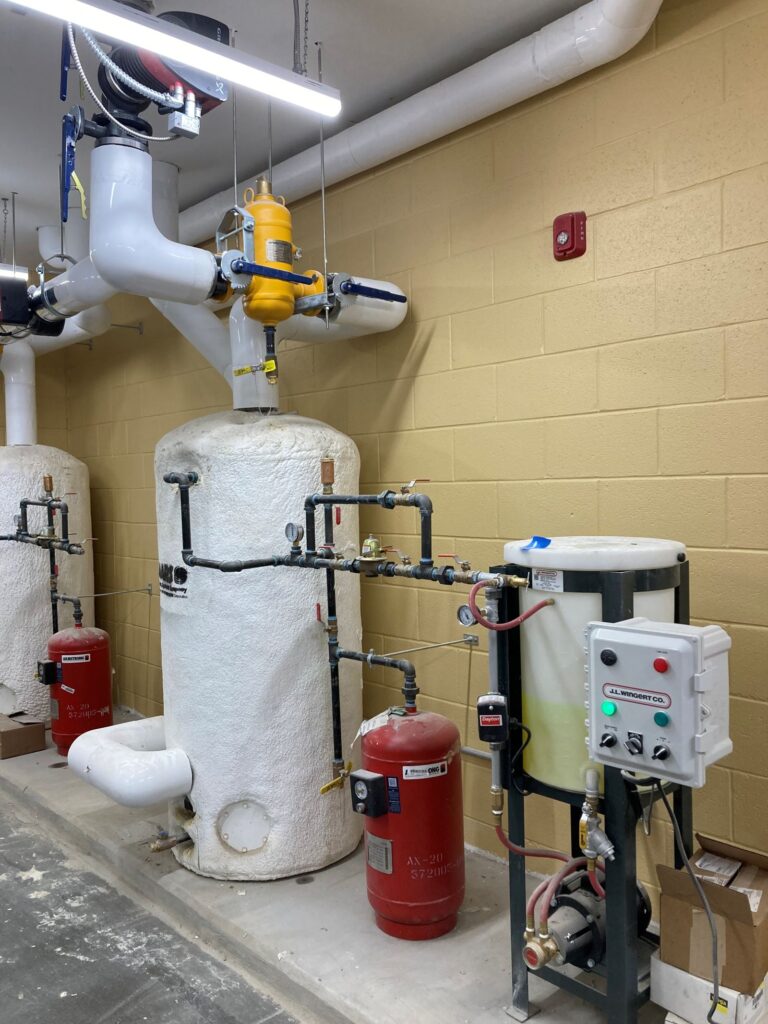
Dane has made remarkable contributions during his time here, with his greatest achievement being the successful boiler change-out at Martha Jefferson House.  This challenging project showcased his technical skills and dedication, and it positively impacted the facility’s efficiency and comfort.

Outside of work, Dane cherishes his time spent outdoors.  While he enjoys a variety of activities, golfing holds a special place in his heart.  Whether perfecting his swing on the greens or soaking in the beauty of nature, he finds immense joy in these moments.  Additionally, he values quality time with his family, creating lasting memories and strengthening those bonds.

We are grateful to have Dane as part of our team, and we look forward to seeing his continued growth and success at Young’s Mechanical Solutions!!

What Facility Managers Should Know Before a Major HVAC System Replacement

At some point, every commercial HVAC system reaches the end of its useful life. When that time comes, the decisions you make before the project starts will have a bigger impact on cost, timeline, and long-term performance than almost anything that happens during installation.

Whether you’re managing an office building, a retail space, a healthcare facility, or a school in the Shenandoah Valley, a major system replacement is a significant capital investment. Here’s what you should be thinking about before the work begins.

Repair vs. Replace: When Is It Time?

The decision to replace a commercial HVAC system is rarely straightforward. Equipment doesn’t always fail all at once—it degrades gradually, with increasing repair frequency, declining efficiency, and rising energy costs. A few key indicators suggest replacement may be the better path: the system is 15–20+ years old, repair costs are escalating year over year, parts are becoming difficult to source, energy bills are climbing despite consistent usage, or the system can no longer maintain consistent comfort throughout the building.

If you’ve been keeping service records—especially through a maintenance agreement—you’ll have the data to make this decision with confidence rather than guesswork.

Full Replacement vs. Phased Approach

Not every replacement needs to happen all at once. Depending on your building’s layout, the number of systems involved, and your budget, a phased replacement approach may make more sense. This allows you to spread capital costs over multiple budget cycles while addressing the most critical equipment first.

A full replacement, on the other hand, can be more efficient from a project management standpoint—one mobilization, one set of permits, and a single coordinated installation. Your mechanical contractor should be able to walk you through both options and help you evaluate what makes the most sense for your situation.

Budgeting Beyond the Equipment

One of the most common mistakes in a system replacement is underestimating the full scope of the project. The cost of the equipment itself is only part of the picture. You should also account for demolition and removal of existing systems, ductwork modifications or replacement, electrical and controls upgrades, structural considerations for heavier or larger units, permitting and inspection requirements in Virginia and West Virginia, and temporary cooling or heating solutions during the transition.

A good mechanical contractor will help you identify these costs upfront so there are no surprises once the project is underway.

Minimizing Disruption to Building Operations

For most commercial buildings, the facility can’t just shut down while HVAC work is completed. Tenants, employees, patients, students—whatever your occupancy looks like—expect the building to function. Planning for minimal disruption should be a central part of your replacement strategy.

This means working with your contractor to schedule work during off-hours or low-occupancy periods, staging the replacement so parts of the building remain operational, planning for temporary heating or cooling during transition periods, and coordinating with other trades if the project involves broader construction.

Experienced commercial mechanical contractors plan around your operations, not the other way around.

Choosing the Right Mechanical Contractor

A major system replacement is not the time to go with the lowest bidder without understanding what you’re getting. The contractor you choose should have deep experience with commercial HVAC systems—not residential. They should be able to demonstrate in-house capabilities including ductwork fabrication, mechanical piping, and controls, carry proper licensing for your jurisdiction, provide references from similar commercial projects, and communicate clearly about timelines, costs, and any issues that arise during the project.

Young’s Mechanical Solutions brings over two decades of commercial mechanical experience, in-house fabrication, and a team that includes sheet metal crews, piping crews, plumbing crews, and controls technicians—all under one roof. We’re licensed in both Virginia and West Virginia.

Thinking Long-Term: Efficiency and Technology

A system replacement is also an opportunity to upgrade. Today’s commercial HVAC equipment offers significantly better energy efficiency, smarter controls, and improved indoor air quality compared to systems installed even ten years ago. If your current system was designed for a different building use or occupancy level, a replacement gives you the chance to right-size and optimize for how the building is actually used today.

Investing in higher-efficiency equipment and modern controls can reduce operating costs for years to come—making the upfront investment easier to justify.

Start the Conversation Early

The best time to start planning a major HVAC replacement is before the old system forces your hand. If you’re seeing the warning signs—rising repair costs, declining performance, aging equipment—now is the time to bring in a commercial mechanical contractor to assess your options.

Contact Young’s Mechanical Solutions to schedule a consultation. We’ll evaluate your current systems, walk you through your options, and help you develop a replacement plan that fits your budget and timeline.

Phone: 540-214-2745

Email: info@youngsmechanicalsolutions.com

Service Area: Harrisonburg, VA and the Shenandoah Valley | Licensed in Virginia and West Virginia

How Service Agreements Reduce Emergency Calls and Protect Your Operating Budget

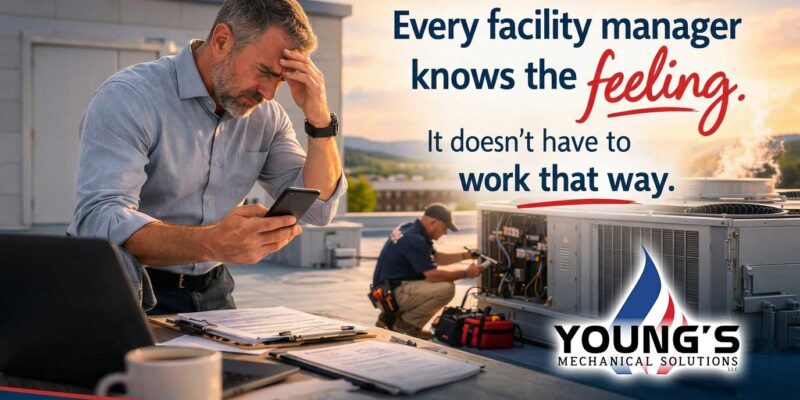
Every facility manager knows the feeling. It’s a Monday morning in July, the building is full, and a rooftop unit goes down. What follows is a scramble—phone calls, emergency service rates, disrupted tenants, and a repair bill that wasn’t in the budget. It doesn’t have to work that way.

A commercial HVAC service agreement is one of the most practical tools a building owner or facility manager can use to stay ahead of mechanical failures, control operating costs, and reduce the frequency and severity of emergency service calls. Here’s how it works—and why it matters for your bottom line.

What a Commercial HVAC Service Agreement Actually Includes

A service agreement isn’t just a promise to show up when something breaks. It’s a structured plan for keeping your commercial mechanical systems operating reliably throughout the year. A well-designed agreement typically covers scheduled preventative maintenance visits, priority response when issues arise, documented inspection and repair history for each piece of equipment, filter changes and belt replacements on a set schedule, and seasonal system checks before heating and cooling seasons.

At Young’s Mechanical Solutions, our service agreements are built around your facility’s specific equipment and usage patterns. We use technology-driven scheduling with repair history tracking, so our technicians arrive knowing your system’s history—not starting from scratch every visit.

Fewer Emergencies, Lower Costs

The most expensive HVAC service call is the one you didn’t see coming. Emergency repairs often come with premium labor rates, overnight parts shipping, and the indirect cost of building downtime. A service agreement flips that equation by catching problems early—before they become emergencies.

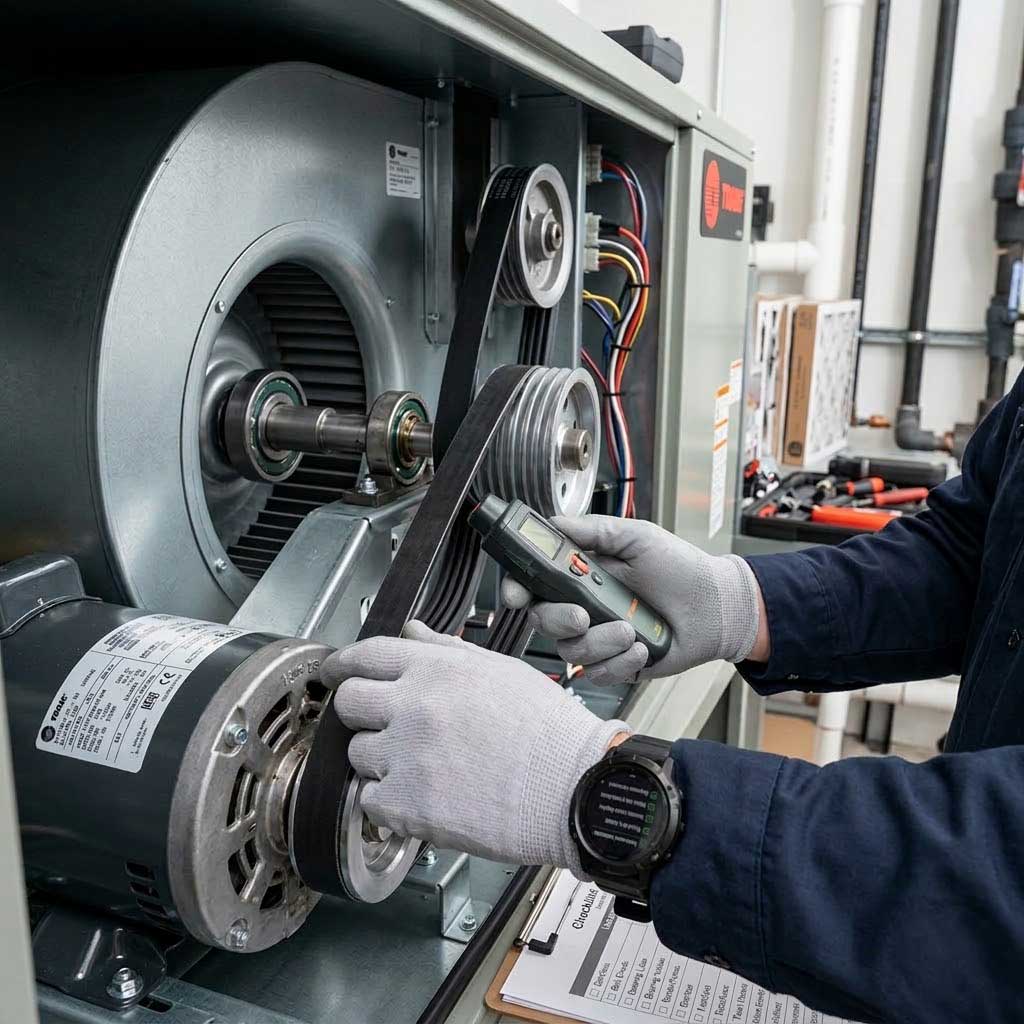
During a routine maintenance visit, a technician might identify a failing compressor, a refrigerant leak, or worn bearings on a blower motor. Addressed early, these are manageable repairs that can be scheduled at a convenient time. Left unchecked, they become emergency calls at the worst possible moment.

For facility managers responsible for multiple buildings or large commercial spaces in the Shenandoah Valley, the math is straightforward: the cost of a service agreement is predictable and budgetable. Emergency repairs are not.

Priority Scheduling When You Need It Most

One of the most valuable—and often overlooked—benefits of a service agreement is priority response. When a facility with a service agreement calls in with an issue, that call goes to the front of the line. During peak heating and cooling seasons, when HVAC contractors across Virginia and West Virginia are stretched thin, that priority access can mean the difference between a same-day repair and waiting days for a technician.

Young’s Mechanical Solutions serves commercial clients within approximately one hour of Harrisonburg, VA, and our service agreement customers are always our first priority when urgent needs arise.

Extending Equipment Life and Protecting Your Investment

Commercial HVAC equipment represents a significant capital investment. Rooftop units, chillers, boilers, and air handlers are designed to last, but only when they receive consistent maintenance. Skipping routine service doesn’t save money—it accelerates wear, reduces efficiency, and shortens the useful life of your equipment.

A service agreement keeps your systems running at peak efficiency, which translates directly into lower energy costs and fewer premature replacements. For building owners focused on long-term operating costs, this is where the real return on investment lives.

Documented History That Supports Better Decisions

Over time, a service agreement builds a detailed record of every inspection, repair, and maintenance visit for your equipment. This history is invaluable when it comes to making capital planning decisions. Rather than guessing when a system might need replacement, you have real data showing trends in repair frequency, performance, and cost.

This documentation also supports warranty claims, insurance requirements, and compliance reporting—all areas where having organized records makes a real difference.

The Right Fit for Your Facility

Not every building needs the same level of service. A small office building has different mechanical demands than a healthcare facility, a school, or a manufacturing plant. The best service agreements are customized to your building’s equipment, age, usage patterns, and operational requirements.

Young’s Mechanical Solutions works with facility managers and building owners across the Shenandoah Valley to design service agreements that make sense for your specific situation—not a one-size-fits-all package.

Take Control of Your Mechanical Maintenance

If you’re managing a commercial facility in Virginia or West Virginia and you’re tired of reacting to equipment failures, a service agreement is the most effective step you can take. It’s a straightforward investment that reduces emergency calls, extends equipment life, and gives you the peace of mind that comes with knowing your building’s mechanical systems are in experienced hands.

Contact Young’s Mechanical Solutions today to schedule a consultation and learn how a service agreement can work for your facility.

Service Area: Harrisonburg, VA and the Shenandoah Valley | Licensed in Virginia and West Virginia

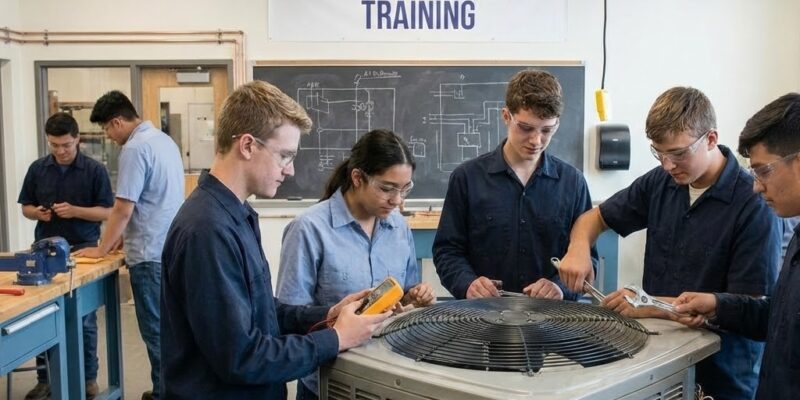
The Skills Schools Try To Teach—and the Mechanical Industry Depends On

Technical training teaches pipe sizing, duct layout and equipment selection, but the
mechanical industry depends equally on soft skills. Problem‑solving, adaptability
and communication are critical to successful HVAC and plumbing careers.
Technicians often encounter unexpected conditions in older buildings in Harrisonburg or
Staunton, requiring quick thinking and collaboration with other trades. Clear
communication with project managers and facility owners ensures that everyone
understands challenges and solutions.

At Young’s Mechanical Solutions, we invest in these skills by fostering teamwork and continuous learning. Our
dedicated team combines decades of experience and expertise to deliver unmatched
HVAC and plumbing services. Crews debrief after each project, sharing lessons
learned and discussing how to improve. We encourage field staff to use digital tools for
service documentation, BIM coordination and equipment commissioning. For individuals
transitioning from the field to the office, we provide mentorship in budgeting, scheduling
and customer relationship management.

We also emphasize community involvement and leadership. Some of our of our employees
volunteer with local organizations like Fire or Rescue departments. They develop leadership and communication skills that
serve them well on the job. We recruit apprentices from local technical centers in helping to build a skilled workforce that
remains in the Shenandoah Valley and Charlottesville area. If you’re interested in a
career that combines technical expertise with soft‑skill development, explore our
Careers page.

Employee Spotlight – Trevor Staton

We’re excited to highlight one of our dedicated HVAC Service Technicians,  Trevor Staton, whose commitment to learning and teamwork makes a strong impact every day.

Since joining the company, he has taken pride in growing his knowledge and expanding his skill set in the field. That dedication has paid off—he’s been promoted in a short amount of time, a reflection of his strong work ethic and eagerness to improve.

What first attracted him to the company was the opportunity to work on large projects and the ability to promote from within—and those opportunities are exactly what continue to keep him here. He appreciates the company culture most, noting that everyone gets along and is always willing to help each other, which makes even challenging jobs go more smoothly.

When asked what advice he’d give to new employees, his answer is simple but powerful: don’t be afraid to reach out for help or ask questions. Learning from others is key to success in this field.

Outside of work, he enjoys restoring classic vehicles, a passion that started early—fun fact: he put together his first vehicle before he could even drive!

He describes the company’s mission as providing quality work in a timely manner to ensure customers’ equipment operates at its best, a value he clearly lives out in his day-to-day work.

We’re proud to have him on the team and look forward to seeing his continued growth and success!