By the time a building’s indoor air quality has noticeably deteriorated, the facility manager is already getting calls. Stuffy classrooms, humid back-of-house corridors, retail spaces that feel clammy by mid-afternoon — these complaints rarely appear on the first hot day of summer. They build up gradually through the season, until something shifts and the whole system stops keeping up. A mid-season indoor air quality check is the most practical way to catch those problems before they turn into complaints, callbacks, or compliance issues.
Why Mid-Season Is When IAQ Problems Surface in Commercial Buildings
Spring startup tests the HVAC system under mild conditions. Equipment cycles, controls respond, and most issues stay hidden because the cooling load is well within capacity. It’s when outdoor temperatures and dew points climb in late June and July that small problems compound — and indoor air quality is usually the first thing to slip.
Three things tend to happen between Memorial Day and the first week of August:
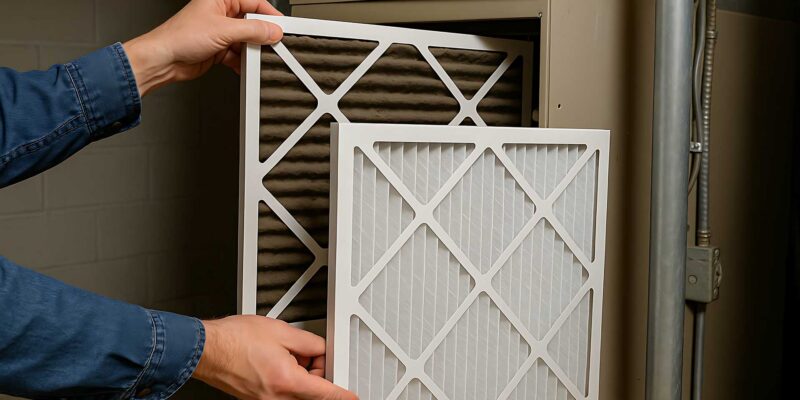
- Filters load up faster than expected. Pollen counts in the Shenandoah Valley peak in spring, but particulate loading continues through summer. Filters that were fresh at startup can be 40–60% loaded by mid-season, restricting airflow and reducing fresh-air delivery.
- Outdoor humidity exceeds design assumptions. Many commercial HVAC systems are designed for a specific outdoor dew point. When humidity stays high for stretches at a time — common in the Valley in July and August — the system has to work harder to dehumidify, and any weak link in the chain shows up.
- Occupancy patterns shift. Schools change to summer schedules, offices run with different staff rotations, retail traffic spikes. The CO2 and moisture loads the system was tuned for in May may not match what’s happening in July.
None of these are catastrophic. But left uncorrected, they translate to comfort complaints, occupant productivity drops, and in regulated environments — healthcare, food service, schools — potential code or operational issues.
The Three Variables That Drive Mid-Summer IAQ Complaints
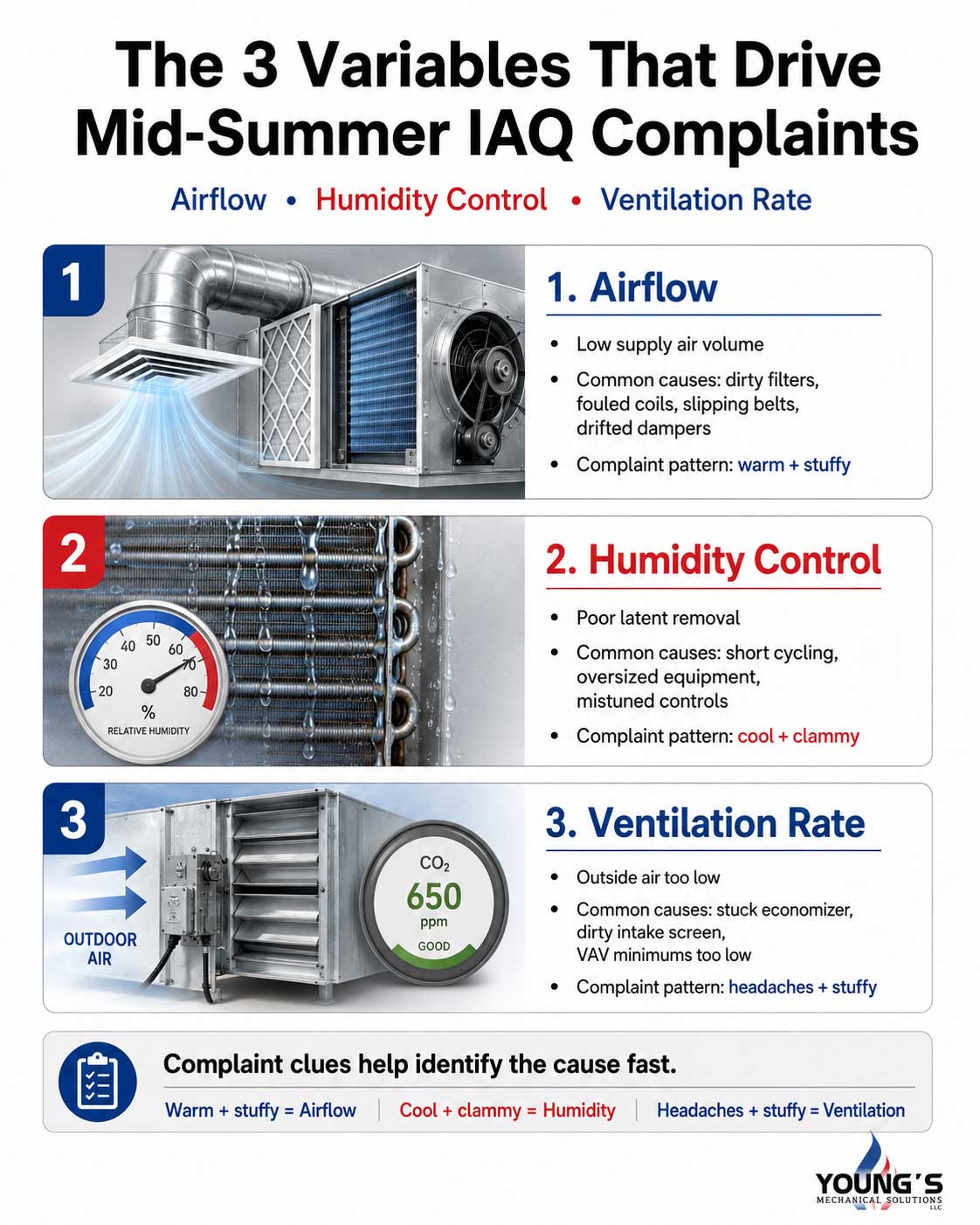 For most commercial buildings, mid-season IAQ problems trace back to one of three things: airflow, humidity control, or ventilation rate. Knowing which one is the culprit dramatically shortens the path to a fix.
Airflow
When supply air volume drops, conditioned air doesn’t reach every zone the way it was designed to. Some spaces overcool while others go warm and stuffy. The most common causes are filter loading, fouled coils, slipping belts on belt-drive units, and dampers that have drifted out of position. Spaces that have been remodeled or reconfigured since the original balance are particularly vulnerable, because the original airflow design no longer matches the current floor plan.
Humidity Control
Commercial HVAC equipment dehumidifies as a function of cooling. When systems are oversized, short-cycle in mild weather, or run with mis-tuned controls, latent removal suffers. Building occupants feel humidity even when the thermostat says the temperature is correct. Common contributors include cooling coils that are bypassed at part load, reheat strategies that are out of calibration, and zones where the supply air dew point doesn’t match the latent load.
Ventilation Rate
Outside-air delivery is the variable most often overlooked at mid-season. Economizer dampers can stick. Outdoor-air intake screens load up with debris. Variable-air-volume systems can reduce ventilation below code-required minimums when zone calls drop. The result is rising CO2, accumulating VOCs, and a building that feels “closed up” even though the HVAC is running.
For facility managers tracking comfort complaints by zone, the pattern of complaints often points directly at which of these three is the issue. Stuffy + warm typically means airflow. Cool + clammy typically means humidity control. Headaches and stuffy without temperature complaint usually means ventilation rate.
A Mid-Season IAQ Check: What Our Service Team Actually Looks At
A practical mid-season IAQ inspection is fast, structured, and focused on the variables that change between startup and peak load. For most commercial buildings, the check takes a few hours and produces a documented punch list of corrections.
The areas we cover:
- Filter inspection and replacement. We measure pressure drop across each filter bank, verify filter rating against current building use, and replace as needed. For buildings with higher-than-baseline particulate loading, we may recommend a step up in MERV rating.
- Coil and condensate inspection. Fouled cooling coils degrade both capacity and dehumidification. Blocked condensate drains create moisture problems on their own. We verify both.
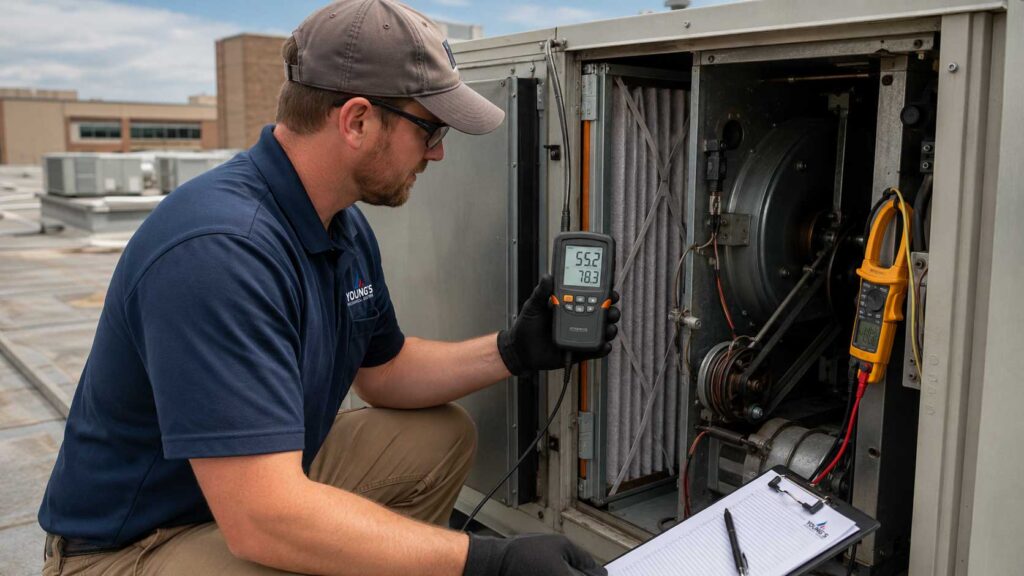
- Outside-air verification. We confirm that economizer dampers are moving freely, outside-air intake is unobstructed, and minimum-position settings match design ventilation requirements. For VAV systems, we check that minimum airflow setpoints are still being met.
- Humidity and dew point measurement. We log space humidity in representative zones and compare it to outdoor conditions and supply-air dew point. Where systems are running with reheat or bypass strategies, we verify they’re calibrated for current conditions.
- Controls calibration. Sensors drift over time. We verify temperature, humidity, and CO2 sensor readings against calibrated instruments and recalibrate where needed.
- Zone walk-through. Where the building has documented complaints, we walk the affected zones and measure airflow, temperature, and humidity directly. The data goes into the documented IAQ record for the building.
The result is a clear, prioritized list of corrections — some of which can be made the same day, some that need scheduled follow-up. For buildings on a service agreement, the check fits into the existing maintenance cycle and is documented in the equipment history.
Where Mid-Season IAQ Issues Show Up First
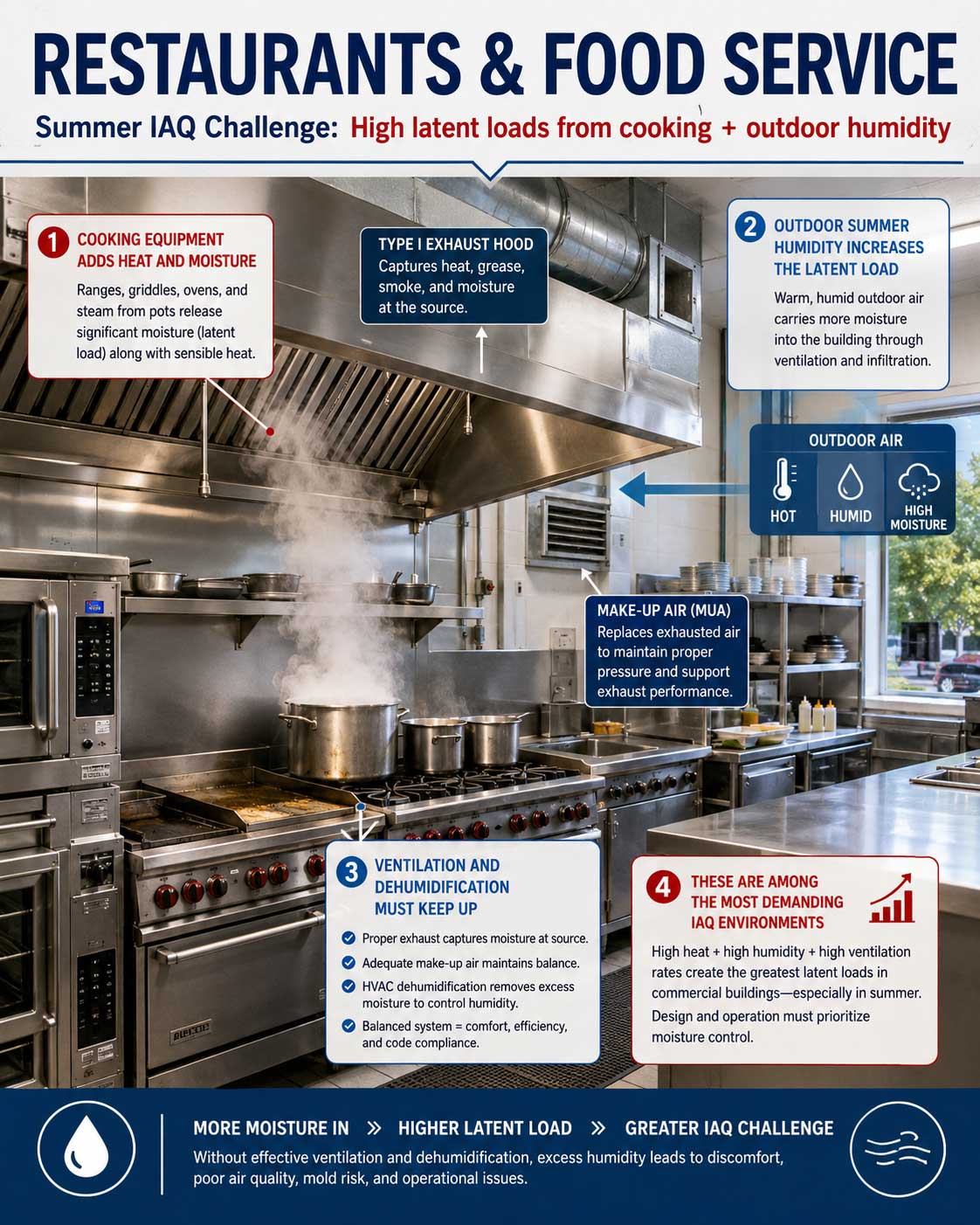 Some commercial spaces are more sensitive to mid-season drift than others. If you manage any of the following, this is the window to act before complaints arrive:
- Schools running summer programs. Reduced occupancy can mean reduced ventilation, but air quality still has to meet code for the students and staff who are present. Mid-summer is also when scheduled deep cleaning and shutdowns happen — a good window for system service.
- Healthcare facilities. Code-driven air-change rates and humidity specs leave little margin. Drift that would be unnoticeable in an office is a documented compliance issue here.
- Multi-tenant offices and retail. Comfort drives lease satisfaction and tenant retention. Stuffy or humid spaces generate complaints that consume facility-team time and damage tenant relationships.
- Restaurants and food service. High latent loads from cooking equipment combined with summer outdoor humidity make these the most demanding IAQ environments in any commercial portfolio.
- Manufacturing and warehouse spaces. Where dew points matter for product quality or process control, humidity drift can affect operations directly, not just comfort.
Building a Reliable IAQ Program Through Service Agreements
One-off IAQ checks fix problems in the moment. A service agreement turns IAQ into an ongoing program. For most facility managers, that’s the difference between reacting to complaints and getting ahead of them.
Our service agreements include scheduled IAQ checks aligned with the cooling and heating seasons, documented equipment performance over time, and continuity of technicians who know your building. When a complaint comes in mid-July, we already have a record of how the system was operating in May and June — which usually shortens diagnosis dramatically.
For buildings in the Shenandoah Valley and West Virginia, that local presence matters. Our service team is dispatched from Harrisonburg, and our in-house crews mean we’re not handing your building off to a rotating chain of subcontractors. The technician who walks your facility this month is part of the same team that’s available when something goes wrong in August.
If your building has been collecting comfort or humidity complaints, or if it has been more than a season since the last documented IAQ check, this is the window to get ahead of the worst part of the summer. Contact our service team at 540-214-2745, or reach out to discuss a service agreement for your building. We will walk your facility, identify what’s drifted, and put a plan in place to keep your indoor air quality where it needs to be.